

Menu


How secure is your digital asset custody - and what does security really mean? Explore different custody models, understand the risks and discover what matters when choosing the right custodian.
Cybersecurity threats are becoming increasingly sophisticated, affecting businesses and financial institutions across industries. The digital asset ecosystem is no exception. Recent security incidents have once again highlighted the growing risks associated with cyberattacks, compromised access credentials and social engineering - where attackers exploit human vulnerabilities rather than technical weaknesses.
In the world of digital assets, the consequences of such incidents can be particularly severe. Unlike traditional financial transactions, blockchain transactions are generally irreversible once confirmed on the network. Assets transferred to an unauthorised address cannot simply be recalled, making the protection of digital assets especially critical.
However, the underlying blockchain technology is rarely the source of these vulnerabilities. Instead, security breaches often arise from weaknesses in custody arrangements, access controls, key management or operational processes. This highlights the importance of robust governance, clearly defined responsibilities and effective security controls throughout the entire custody lifecycle.
Secure custody goes beyond technology. It requires a comprehensive approach that combines advanced security infrastructure with strong operational governance, rigorous risk management and clearly defined processes to protect digital assets against both external threats and internal vulnerabilities.
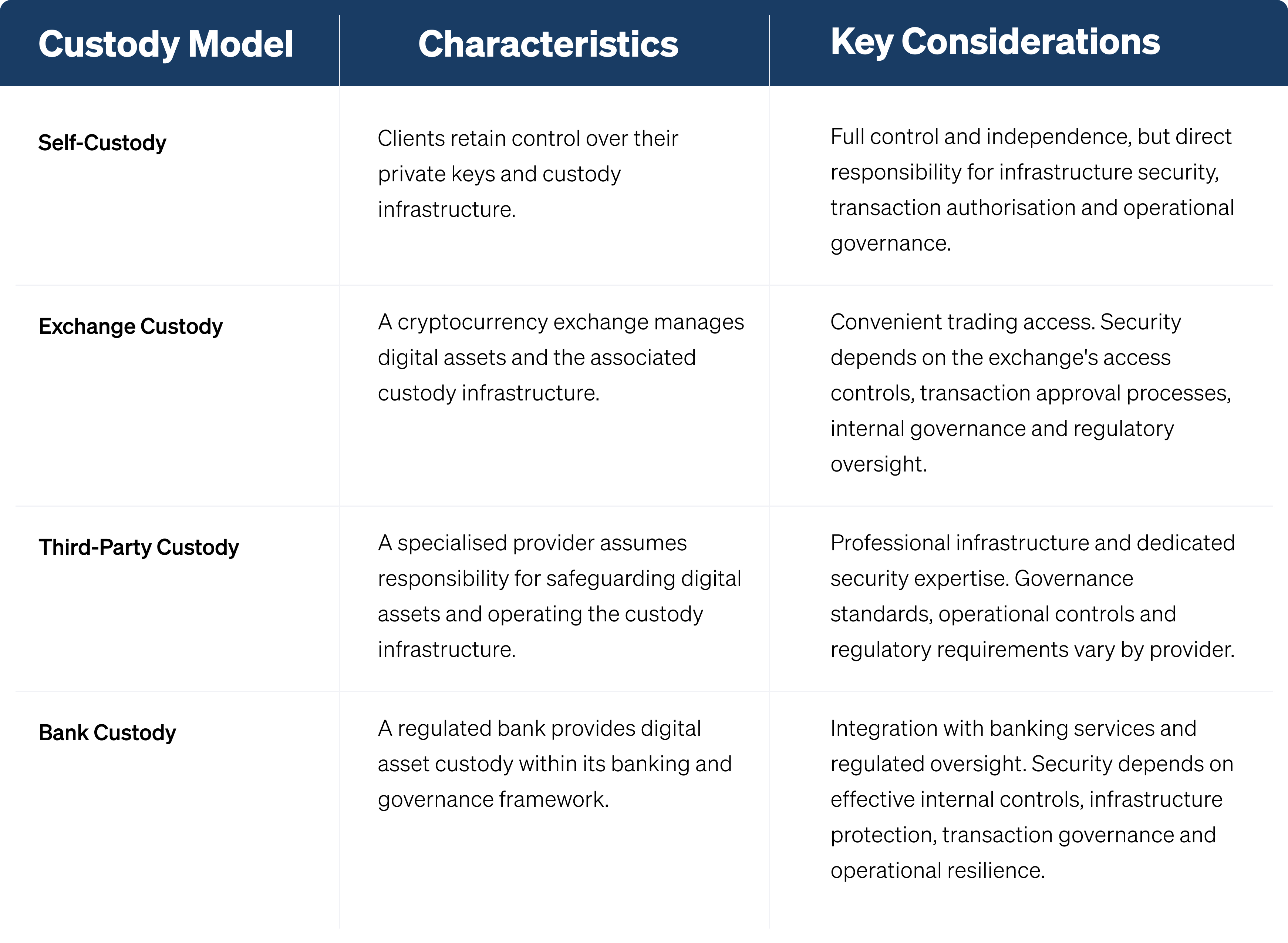
Custody models differ primarily in who assumes responsibility for safeguarding digital assets and managing the underlying infrastructure. However, security depends on more than private key protection. Effective access controls, transaction authorisation procedures and operational governance are essential to prevent compromised systems or credentials from enabling unauthorised transfers.
Regardless of the custody model, the decisive factor is how effectively the responsible institution manages these risks.
Secure digital asset custody requires more than advanced technology. While cryptographic security and sophisticated infrastructure are essential, they represent only one part of a comprehensive security framework.
A truly secure custody solution combines technical safeguards, strong operational governance, cyber resilience and regulatory oversight. These elements must work together to minimise the risk of unauthorised access, operational failures and the irreversible loss of digital assets.
The foundation of secure custody lies in robust technical infrastructure designed to protect private keys and prevent unauthorised access.
This includes advanced key management solutions, secure key generation and storage, multi-party computation (MPC) or other appropriate cryptographic safeguards, as well as strict access controls and continuous infrastructure monitoring.
However, even the most sophisticated technology cannot eliminate every risk. Technical security must be supported by regularly tested systems, effective vulnerability management and a comprehensive approach to cybersecurity.
Technology alone cannot prevent security breaches if operational processes and internal controls are insufficient.
Strong operational governance ensures that critical activities are subject to clearly defined responsibilities, segregation of duties and appropriate authorisation procedures. Dual-control mechanisms and multi-level transaction approvals help prevent individual employees or compromised accounts from initiating unauthorised asset transfers.
Continuous monitoring, incident response procedures and business continuity planning further strengthen the ability to identify threats, respond to incidents and maintain critical operations.
Particular attention must be paid to human vulnerabilities, including social engineering, which remains a significant attack vector even in highly secured environments.
Beyond preventing attacks, custody providers must be prepared to withstand, respond to and recover from cybersecurity incidents.
This requires a structured approach to ICT risk management, regular security assessments, penetration testing, disaster recovery planning and the management of risks associated with third-party technology providers.
The EU's Digital Operational Resilience Act (DORA) establishes a regulatory framework addressing these areas across the financial sector. It emphasises that cybersecurity is not simply a technical responsibility, but an integral part of enterprise-wide risk management and operational resilience.
For digital asset custody providers, this is particularly important given the potentially irreversible consequences of compromised private keys or unauthorised blockchain transactions.
Regulatory supervision provides an additional layer of accountability by establishing requirements for governance, risk management, operational controls and the safeguarding of client assets.
Under the EU's Markets in Crypto-Assets Regulation (MiCAR), Article 75 sets out specific obligations for providers offering custody and administration of crypto-assets, including documented custody policies, appropriate safeguarding procedures and responsibilities relating to the loss of client assets.
However, regulatory compliance and the legal segregation of client assets should not be mistaken for comprehensive protection against all risks. Crypto-assets held in custody are not covered by deposit guarantee schemes, including when held with a regulated bank. While legal safeguards are important for establishing ownership rights and addressing insolvency scenarios, they do not prevent losses resulting from compromised keys or unauthorised transactions.
Independent assurance can therefore provide additional confidence. External security audits and recognised assurance frameworks, such as SOC2 reports, can help demonstrate that a provider's security controls and operational processes have been independently assessed.
Ultimately, regulatory authorisation, independent assurance and robust internal controls should complement one another rather than be viewed as substitutes for effective technical and operational security.
Secure custody is not defined by a single technology, license or certification. It is the result of a comprehensive security framework in which technology, governance, cyber resilience and regulatory accountability work together to protect digital assets.
Choosing the right custody provider is an important decision for any individual or institution holding digital assets. Beyond comparing technologies and service offerings, clients should carefully assess the security infrastructure, operational governance and resilience of their potential custodian.
The following eight questions provide a practical framework for evaluating whether a custody provider has the necessary safeguards in place.
Consider where the custodian is established, which regulatory authority supervises its activities and whether it is subject to comprehensive cybersecurity and operational resilience requirements, such as those established under DORA in the EU.
Assess whether the provider uses proprietary infrastructure or established third-party solutions, and whether technologies such as Multi-Party Computation (MPC) or Hardware Security Modules (HSMs) are employed. Understand who controls the keys, where they are stored and which external providers are involved.
Verify that transaction creation and approval are separated through clearly defined responsibilities, segregation of duties and dual-control mechanisms. No single individual should be able to independently initiate and authorise sensitive asset transfers.
Evaluate the use of role-based access controls, multi-factor authentication, privileged access management and continuous monitoring to prevent unauthorised access or misuse of sensitive systems.
Examine employee security awareness programmes, identity verification procedures, access reviews and safeguards designed to prevent compromised credentials or manipulated employees from enabling unauthorised transactions.
Ask whether the provider undergoes independent security audits, penetration testing and recognised assurance assessments, such as SOC1 or SOC2, and whether its applicable ICT risk management and testing requirements under DORA are addressed.
Determine whether the provider has documented incident response plans, disaster recovery capabilities and regularly tested business continuity procedures to maintain critical services and respond effectively to security incidents.
Understand how the provider assesses, monitors and controls dependencies on external technology partners, including key management providers, cloud infrastructure and other critical ICT service providers. Particular attention should be paid to operational dependencies, access rights and contingency arrangements.
The key takeaway: A trustworthy custody provider should be able to demonstrate not only how digital assets are technically protected, but also how security is governed, independently assessed and maintained under adverse conditions.
As digital assets become increasingly important, secure custody requires more than advanced key management. Strong internal governance, clearly defined responsibilities and robust operational controls are equally essential to prevent unauthorised access and transactions.
At the same time, increasing regulatory requirements, particularly around cybersecurity and operational resilience in Europe, highlight the importance of a comprehensive approach to digital asset security.
As a Liechtenstein-licensed bank supervised by the FMA and authorised under MiCAR, Celsion Bank combines traditional banking infrastructure with digital asset custody and trading services on an integrated platform.
This approach enables clients to manage their digital assets within a regulated banking environment, combining technical safeguards, operational governance and integrated financial services.
Because secure custody goes beyond protecting private keys - it requires protecting the entire ecosystem surrounding digital assets.
Secure digital asset custody is not defined by technology alone. Even the most advanced security infrastructure can be compromised without strong operational governance, effective risk management and clear accountability.
Ultimately, the security of digital assets depends not only on how private keys are protected, but also on the institution responsible for managing the underlying infrastructure and processes.
Three principles are essential:
The question is not simply how your assets are protected, but who is responsible for protecting them and how.
Pascal John is Head of Operations at Celsion Bank, bringing over 10 years of experience in banking and financial services. In his role, he oversees operational processes and contributes to the development of the bank's digital asset services. His professional interests include banking operations, financial technology and the evolving regulatory landscape of digital assets.


Expect the latest and most important news, updates, and insights delivered straight to your inbox.